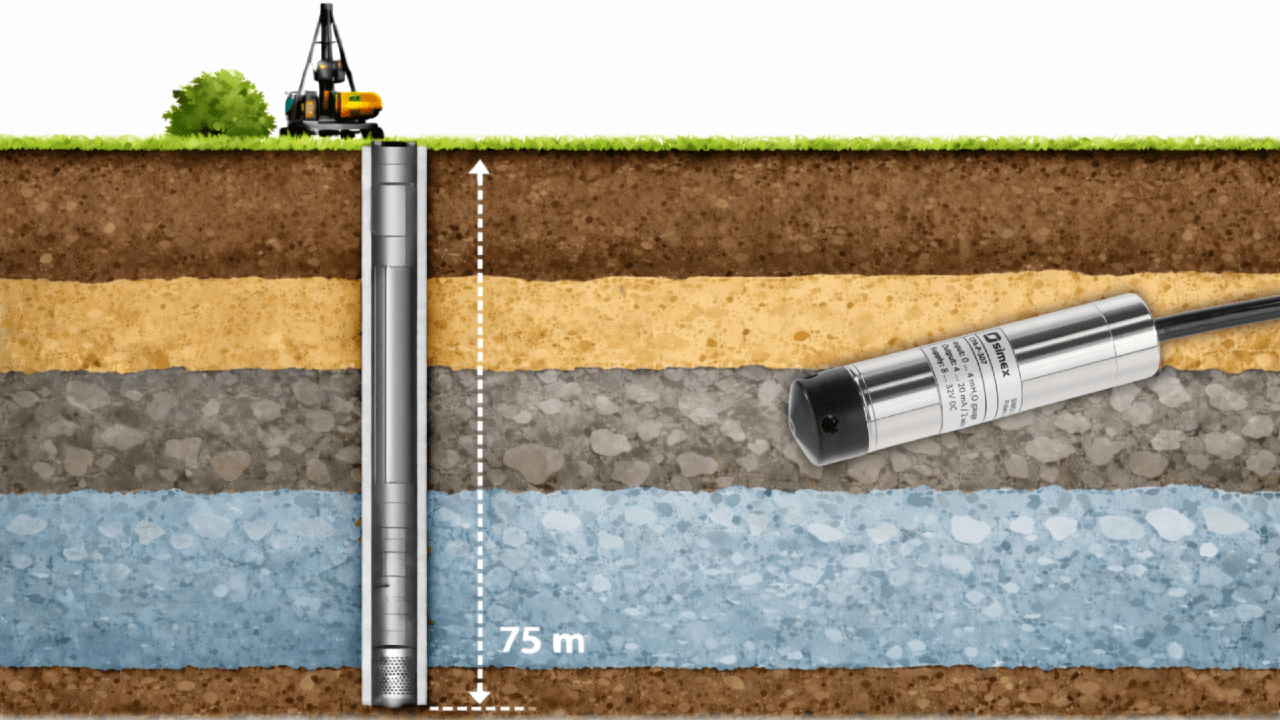
Measurement of Borehole Filling Level with Explosive Mixture
In one of the open-pit mines, a critical question arose: is a borehole filled with an explosive mixture (50/50 emulsion) properly filled along its entire depth? We are talking about holes reaching depths of up to 75 meters – and at such depths, every meter matters.
The answer is the measurement of hydrostatic pressure at different depths of the borehole.
In the application, the following were used:
- CPA-P-307 hydrostatic probe – a submersible level transmitter (stainless steel, 4–20 mA output, IP68 protection rating)
- MultiCon CMC-N16 data recorder (wall-mounted version) – used as a data concentrator and recorder
Sensors placed at different levels of the borehole measure the actual pressure exerted by the column of material.
Based on this, it is possible to:
- determine the actual filling height
- estimate the amount of applied substance
- detect discontinuities (e.g., air pockets)
- analyze changes over time
Why does it work?
Hydrostatic pressure is directly proportional to the height and density of the liquid column. If the borehole is not filled uniformly, the graph will immediately reveal it.
MultiCon CMC-N16:
- records signals from multiple sensors simultaneously,
- visualizes data locally,
- enables analysis of trends over time,
- archives data for further technological evaluation.
What’s the most interesting part?
This is an application where a classic level measurement becomes a tool for verifying the quality of the blasting process.
- Without additional complex systems.
- Without guesswork.
- With hard data.
If you have an application where a difficult medium and demanding conditions raise measurement concerns — let’s talk. Often, the solution is simpler than it seems.
Simex – we measure where others only estimate.